
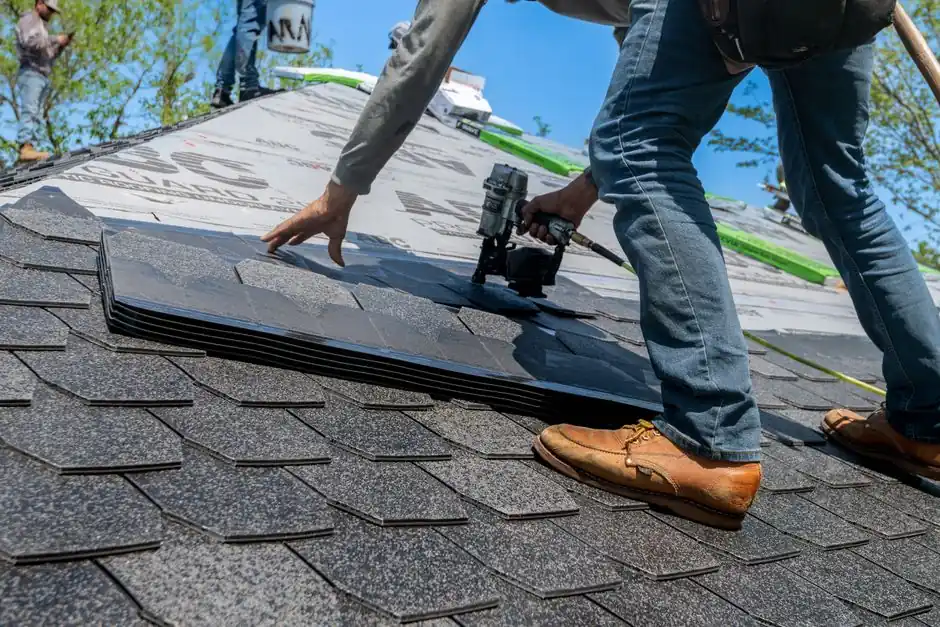
For a typical New York home with a pitched roof, asphalt shingles are the better choice; for a flat or low-slope roof, a membrane flat roof is the only correct option, and shingles should never be installed on a slope under 2:12. That is the whole answer. Everything below explains why the slope of your roof, not your budget or your neighbor's opinion, decides this for you.
We install and repair both systems across the region, and we have pulled shingles off flat roofs that should never have been there. This guide covers how New York weather treats each roof, what each costs in 2026, how long each lasts, and how to tell which one your house actually needs.
The short answer for New York homeowners
Flat roof vs shingle roof in New York is not a style preference - it is an engineering question decided by roof pitch, drainage, and snow load. Shingles shed water and snow by gravity on slopes of 2:12 or steeper. Flat and low-slope roofs hold water until it finds the drain, so they need a continuous membrane with sealed seams, not overlapping tabs.
Here is the rule we use on every estimate:
- Slope 2:12 or steeper: asphalt shingles, almost always.
- Slope under 2:12: flat roofing membrane - TPO, EPDM, or modified bitumen.
- Mixed roof (flat porch or addition plus pitched main): both systems on the same house, done correctly at the transition.
If someone offers to shingle a flat roof, walk away. Water will sit under the tabs, freeze, and lift them within two winters.
How New York weather punishes the wrong roof
New York roofs face a freeze-thaw cycle that runs from roughly late November through March, and that cycle is what kills roofs here, not the summer heat. Water gets into a seam or a lifted tab, freezes overnight, expands about 9 percent, and pries the material apart. Repeat that 40 to 60 times a winter and small defects become leaks.
Snow load matters too. New York ground snow loads run from about 30 psf in the lower Hudson Valley and Long Island up to 50 psf and higher in parts of the Catskills and western New York. A pitched shingle roof sheds most of that on its own. A flat roof carries it until you or the sun removes it, which is why flat roofs here need clear drainage paths and, on older buildings, a structural check before we add any insulation weight.
Then there is the coastal piece. Along the South Shore and the barrier beaches, salt air and wind-driven rain work on fasteners and flashing year-round. We see corroded nails and lifted edge metal on homes in Roofing in Bay Shore far more often than on inland roofs of the same age.
Bottom line: shingles handle snow well and wind poorly at the edges; flat membranes handle wind well and snow poorly if drains clog. Each system fails in a predictable place, and that is what we inspect for.
Flat roof vs shingle roof in New York: cost comparison
Flat roof vs shingle roof in New York comes down to installed cost per square, and shingles win on price for most pitched homes. Typical 2026 pricing in this area, installed with tear-off of one existing layer:
- Asphalt shingles: $6.50 to $11.00 per square foot, or roughly $11,000 to $19,000 for a 1,700 sq ft roof.
- Flat membrane (TPO or EPDM): $8.00 to $14.00 per square foot, or roughly $8,000 to $14,000 for a 1,000 sq ft flat roof.
- Modified bitumen: $7.00 to $12.00 per square foot, common on New York City row houses and two-family homes.
Two things move those numbers more than material choice. First, tear-off: a second layer of shingles adds $1.50 to $3.00 per square foot, and most New York codes limit you to two layers total. Second, access. A three-story Brooklyn rowhouse with no driveway costs more to roof than a ranch in Roofing in Bethpage with the same square footage, because every bundle goes up by ladder or conveyor.
Do not compare a flat roof quote to a shingle quote on the same house unless the house genuinely has both roof types. They are different systems with different labor, and the cheaper number is not automatically the better value.
Lifespan: how long each roof actually lasts here
A properly installed asphalt shingle roof lasts 18 to 25 years in New York, and a flat membrane lasts 15 to 25 years depending on material and maintenance. Manufacturer ratings assume ideal conditions; our freeze-thaw cycle and summer UV cut the top end off those numbers.
What we actually see:
- 3-tab shingles: 12 to 18 years. We stopped recommending them for anything but sheds and outbuildings.
- Architectural shingles: 20 to 25 years when attic ventilation is correct.
- TPO membrane: 18 to 25 years, longer if seams are heat-welded and drains stay clear.
- EPDM: 20 to 25 years, but seams and penetrations need checking every few years.
- Modified bitumen: 15 to 20 years on New York City rowhouses.
Two maintenance habits add years to either system: clearing debris off flat roofs before the first freeze, and keeping gutters and valleys clear on shingle roofs so ice does not back up under the bottom courses. A $400 to $700 annual roof maintenance in New York visit is cheaper than any replacement.
Which roof is better for New York homes by building type
Which roof is better for New York homes depends on the building, not the neighborhood. Here is how we sort it on the first visit.
Colonial, cape, and ranch houses
These have pitched roofs at 4:12 or steeper. Shingles are correct, full stop. If you are replacing, architectural shingles over a synthetic underlayment and ice-and-water shield at the eaves and valleys is the standard we install.
Brooklyn and Queens row houses
Most have a flat main roof and a small pitched section over the front. The flat portion gets modified bitumen or TPO; the pitched portion gets shingles. When we do a roof replacement in New York on these buildings, the transition flashing between the two systems is where we spend the most time, because that is where 80 percent of the leaks start.
Additions, porches, and garages
Low-slope additions are everywhere on Long Island and in Westchester. These are flat-roof territory even when the main house is shingled. If your addition has shingles on a 1:12 slope, that roof is already failing and you may just not have noticed yet.
Commercial and mixed-use buildings
Flat membrane, always. Foot traffic, HVAC units, and drains all point to a single-ply system you can walk on and repair in sections.
Common mistakes we see on New York roofs
The most expensive roof mistakes in New York come from applying the wrong system to the wrong slope, and they usually show up two winters later. Here is what we find most often:
- Shingles on a flat roof. Sometimes with a layer of rolled roofing underneath to "seal it." It never works.
- Sealing a flat roof with roof cement. A tube of tar over a split seam buys you one season. The membrane underneath is still failing.
- Skipping ice-and-water shield at the eaves. Ice dams form, water backs up under the shingles, and you get a ceiling stain in February.
- Adding a second layer of shingles to save money. It traps heat, hides deck rot, and adds 2 to 4 psf of dead load you did not need.
- Ignoring attic ventilation. Poor intake and exhaust vents cook shingles from below and cut their life by five years or more.
- Letting flat roof drains clog. Leaves and grit block the drain, ponding water sits, and the freeze-thaw cycle does the rest.
None of these are exotic. They are the same six problems we document on estimates every week.
When to call a professional
Call us when you see any of these: granules piling up in the gutter, a ceiling stain that grows after rain, shingles curling or losing their tabs, a flat roof that stays wet 48 hours after the rain stops, or ice dam damage along the eaves. Those are not cosmetic issues.
We start with a roof inspection in New York - we walk the roof, photograph every defect, check the attic and flashing, and tell you whether you are looking at a repair or a replacement. If it is a repair, we fix it. If it is a replacement, we quote both systems where both are viable and explain the trade-offs in plain numbers. If water is actively coming in, our emergency roofing services in New York run around the clock.
Frequently Asked Questions
Which is better for New York homes, flat roof or shingle roof?
Shingles are better on pitched roofs of 2:12 or steeper; flat membrane is better on anything flatter. Match the system to the slope and both perform well. Put the wrong one on and you will be repairing it within two winters.
How do flat roofs compare to shingle roofs in New York?
Flat roofs cost $8 to $14 per square foot installed and last 15 to 25 years. Shingles cost $6.50 to $11 per square foot and last 18 to 25 years. Shingles shed snow better; flat membranes handle wind and foot traffic better.
What roof type is best for New York weather?
Architectural asphalt shingles on pitched roofs and TPO or EPDM on flat roofs. Both handle our freeze-thaw cycle when installed with ice-and-water shield, correct flashing, and clear drainage. No single material wins everywhere.
Are flat roofs good for New York homes?
Yes, on low-slope buildings. They handle snow load up to their structural rating, resist wind well, and are easy to repair in sections. They need annual drain clearing and a structural check before adding insulation weight.
Can I put shingles over a flat roof to save money?
No. Shingles need at least a 2:12 slope to shed water. On a flat roof, water sits under the tabs, freezes, and lifts them. The repair cost will exceed whatever you saved on the original install.
Get help with Roofing in New York
Whether your house needs shingles, a flat membrane, or both, we will tell you straight which one fits and what it costs. Call RoofPros New York at (833) 829-2623 and we will schedule a roof inspection at your home.