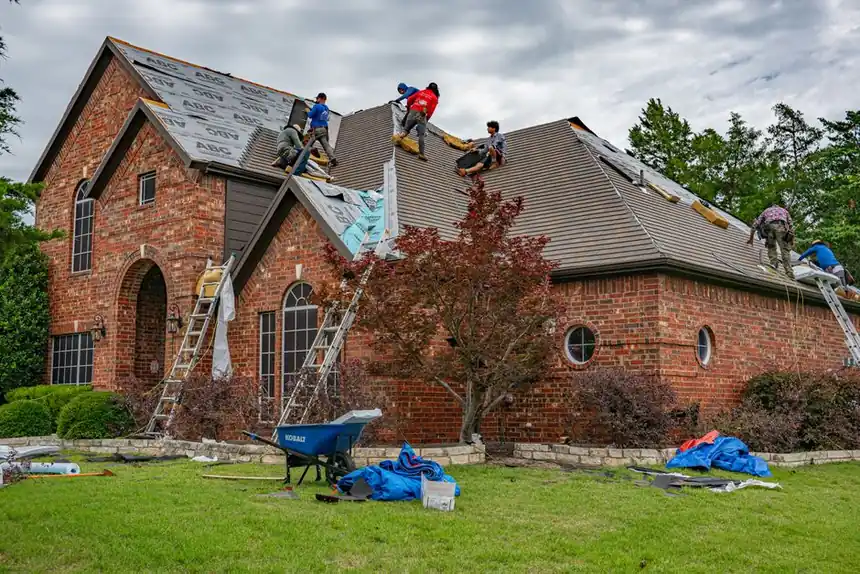
Full Tear Off to Deck
We remove every layer of old roofing, felt, and nails down to the wood. No overlays, ever. That lets us inspect the decking and fix rot before it gets covered up, which is the single biggest reason cheap roof jobs fail early.
Every roof replacement we sell is a complete system, not a shingle overlay. The list below is standard on our bids. Upgrades like standing seam metal, slate, or upgraded shingle lines are quoted separately, and we tell you the difference in writing before you decide.
We remove every layer of old roofing, felt, and nails down to the wood. No overlays, ever. That lets us inspect the decking and fix rot before it gets covered up, which is the single biggest reason cheap roof jobs fail early.
A self-adhering membrane along the eaves, valleys, and all penetrations. This is what stops ice dams from backing water under your shingles in February. It is required by code in many New York jurisdictions and we install it everywhere regardless.
Chimney flashing, step flashing, pipe boots, and drip edge all get replaced, not reused. Flashing failure causes the majority of leaks we get called to, and reusing old metal is how a new roof starts leaking in year three.
A full synthetic underlayment across the field, which handles foot traffic during installation and resists tearing far better than old felt paper. It is the secondary water barrier under your shingles and it matters when wind drives rain sideways.
We install a new ridge vent and confirm your soffit intake is open and sized correctly. Balanced ventilation keeps the attic dry, extends shingle life, and prevents the heat buildup that cooks roof decking from the underside.
Tarps over landscaping, a dumpster on site, and two magnetic sweeps for nails. We haul every shingle off your property. Customers with kids and dogs tell us this is the part they appreciate most.
Roof replacement in New York means stripping the roof down to the decking, replacing any rotted sheathing, and rebuilding the whole assembly: ice and water shield along the eaves and valleys, synthetic underlayment across the field, new drip edge, new flashing, and a full shingle or membrane system on top. It is not an overlay. We pull the old asphalt shingles, the felt, and the nails with a roofing hammer and pry bar, then run a magnetic sweep of your lawn and driveway before we leave.
Most New York homes we see are carrying two or three layers of shingles from prior overlays, and the extra weight plus trapped heat shortens the life of everything underneath. If your roof is 20 years old, losing granules, or showing hail damage after a summer storm, a full roof replacement New York project is usually cheaper over ten years than patching the same leaks twice. We give you a written scope and a fixed price before the first shingle comes off.
Every job follows the same sequence, whether it is a 1,200 square foot ranch in Lindenhurst or a steep Victorian in Mount Kisco. Here is what you will see from us.
Schedule
Call or book online — a real human picks up and confirms a 2-hour arrival window.
Diagnose
Licensed tech inspects on-site, then walks you through the cause and your options.
Fix
The job is completed to code and done right the first time — no shortcuts, no surprises.
Guarantee
Every job backed by a written workmanship warranty — and we stand behind it.
 Tools & Equipment
Roofing nailer and nail gun
Set to the manufacturer's depth and pattern so shingles seat without tearing. We check calibration daily, because an over-driven nail is a leak waiting to happen.
Pry bar and shingle cutter
Used during tear off to lift shingle courses cleanly and cut around valleys and penetrations without damaging the decking underneath.
Chalk line and roofing ladder
The chalk line keeps every course straight across the roof, and the ladder system gets us on and off steep pitches safely without walking the shingles.
Safety harness and fall protection
OSHA-compliant harnesses and anchor points on every pitch above six feet. Fall protection is not optional on our sites, for any crew member, on any job.
Roofing torch and cement
Used for detailing modified bitumen and sealing specific flashing joints where a mechanical fastener alone will not hold against driven rain.
GAF Master Elite installation standard
We follow the manufacturer's published installation requirements for nailing pattern, underlayment, and ventilation. Meeting that standard is what qualifies the roof for an enhanced warranty rather than a basic one.
Ice and water shield at eaves and valleys
Applied to code on every roof, not just where it is required. It is the layer that protects your home during the freeze-thaw cycles that define New York winters.
Balanced attic ventilation
We size ridge vent to soffit intake so air moves through the attic instead of sitting in it. Unbalanced ventilation is one of the most common causes of premature shingle failure we find.
Magnetic sweep and site protection
Tarps over landscaping before tear off, and two magnetic sweeps for nails after. We treat your property like our own, because a nail in a tire is a real cost to you.
01
What we do: We inspect the deck, measure the squares, and quote a full tear off and replace with a fixed price. You see the scope in writing before any work starts, including the decking allowance.
→ A new roof system with a manufacturer warranty, and no more annual repair calls. Most customers stop budgeting for roof patches entirely.
02
What we do: We provide a written scope, photos, and a fixed price fast, so the deal does not stall. If replacement is the right call, we schedule it around your closing timeline.
→ A documented roof replacement with a transferable warranty, which removes the roof as a negotiating point and satisfies the buyer's lender.
03
What we do: We tarp the roof immediately, document the damage with photos and measurements, and meet the adjuster on site with a written scope that matches the claim.
→ A clean claim file and a scheduled replacement, with the emergency tarp handled the same day you call.
04
What we do: We inspect before closing, photograph the deck and flashing, and give you a written replacement quote so you can negotiate with real numbers instead of a guess.
→ You walk into closing knowing exactly what the roof needs and what it costs, with no surprises after you get the keys.
New York roofs face three different climates in one state. Along the coast from Freeport to Westhampton, salt air corrodes flashing and fasteners faster, and wind uplift is the design driver, so we spec higher wind ratings and stainless details near the shore. In the Hudson Valley and up through Beacon, Newburgh, and Wappingers Falls, the freeze-thaw cycle is brutal: ice dams form along the eaves, and cheap flashing cracks within two winters. Up in Schenectady and Troy, snow load and lake-effect moisture drive the spec. We also work in older building stock, from Bronx walk-ups to Hudson Valley farmhouses, where decking is often 1x6 plank rather than plywood and needs different fastening. If you are comparing roof replacement cost in New York across quotes, ask what underlayment and ice shield each bid includes. That is where the real difference lives.
Bronx
Dense rowhouse and walk-up stock with flat and low-slope roofs. TPO membrane and modified bitumen are common, and access planning matters as much as the roofing itself.
Staten Island
A mix of steep pitched homes and flat garage roofs. Wind exposure on the higher elevations means we spec higher uplift ratings and check every ridge cap.
Mount Kisco
Older Hudson Valley homes with plank decking and complex rooflines. Dormers, valleys, and chimneys need detailed flashing work, not a fast shingle-over.
Lindenhurst
South Shore capes and ranches hit hard by coastal storms. Many carry two layers of shingles, so tear off weight and disposal planning are part of every bid.
Lake-effect snow and heavy winter loads
Roofs need proper ice and water shield and adequate ventilation to prevent dams. We size the assembly for the load rather than the minimum code.
Coastal salt air and wind uplift
Fasteners and flashing corrode faster near the shore, and wind ratings matter. We use corrosion-resistant details and higher wind-rated shingle systems on coastal homes.
Freeze-thaw cycles in the Hudson Valley
Repeated expansion and contraction cracks cheap flashing and sealant. We replace all flashing rather than reusing it, which is why our roofs hold through multiple winters.
Older housing stock with plank decking
Plank decks need different nailing and sometimes sheathing overlay. We inspect board by board and price decking repairs per sheet so there are no surprises.
Most roofs we replace were patched three or four times before the owner gave up. Here are the failures we see most often, and what we do about them.
Problem
Ceiling stains, insulation damage, and eventually rotted framing. Each patch buys less time than the last, and you keep paying for the same fix.
Our Fix
We trace the leak to its actual source, usually flashing at a chimney, vent, or valley. Then we replace the full assembly around it so the repair is permanent instead of another bandage on a failing roof.
Problem
Exposed underlayment takes on water fast, and a single missing ridge cap can let water into the attic within one rain event. Insurance claims get harder to file the longer you wait.
Our Fix
We tarp the same day, document the damage with photos and measurements for your adjuster, and schedule the replacement once the claim is approved. Storm damage roof repair and full replacement both run through the same crew.
Problem
Water backs up under the shingles and into exterior walls, causing rot, mold, and peeling paint inside. It repeats every year until the roof assembly is corrected.
Our Fix
We install ice and water shield to code, correct the attic insulation and ventilation balance, and replace any rotted decking we find. That combination stops the melt-refreeze cycle that causes dams in the first place.
Problem
Standing water finds every seam and penetration. On flat roofs it accelerates membrane failure, and on pitched roofs it rots the fascia and soffit behind the gutter.
Our Fix
We clear and re-pitch gutters, replace damaged fascia, and on flat roofs install TPO membrane with properly detailed drains and seams so water moves off the roof instead of sitting on it.

A complete tear off resets the clock on your entire roof system, not just the top layer. Here is what that buys you in New York.
Stops Repeat Leaks
Patching a flashing failure or a wind-uplifted ridge cap buys you months, not years. A full tear off lets us replace the underlayment, ice and water shield, and every piece of flashing at once, so the leak path is gone instead of rerouted. Most customers stop calling us after the first winter.
Restores Curb Appeal
A new roof is the single biggest visual change you can make to a house. We install Owens Corning Duration and GAF Timberline shingles in colors matched to your siding and trim, and we replace the ridge vent so the roofline reads clean and straight from the street.
Improves Energy Performance
New ridge venting paired with proper intake at the soffits drops attic temperatures by 15 to 25 degrees on a July afternoon. That takes load off your AC and helps prevent the moisture buildup that rots roof decking from the underside. Ventilation is part of the bid, not an upsell.
Protects Home Value
Buyers and inspectors flag a worn roof immediately. A documented full roof replacement New York installation with a manufacturer warranty transfers to the next owner, which removes a negotiating chip at sale time and keeps your insurance carrier satisfied after a storm claim.
Honest 2026 pricing for a full roof replacement in New York runs $9,500 to $24,000 for most single-family homes, with the average near $14,000. Asphalt shingle systems sit at the lower end. Metal, slate, and flat TPO membrane run higher. The number moves with square footage, pitch, how many layers need tearing off, and how much decking needs replacing. We give you a fixed written price after the inspection, and financing is available if you want to spread the cost.
Typical Investment Range
$9,500 - $24,000 depending on size, pitch, layers, and material
A new roof resets the clock on the entire assembly, not just the top layer. Spread over 25 to 30 years, the annual cost is a fraction of what repeated repairs and water damage add up to. Financing is available to spread the upfront cost.
What changes the price
Roof size and pitch
Square count is the biggest driver, and steep pitches add labor and safety time. A simple low-slope ranch prices far below a steep multi-gable colonial of the same footprint.
Layers to tear off
Each additional layer of old shingles adds disposal weight and labor. Two-layer tear offs are common on Long Island and add meaningful cost versus a single-layer roof.
Decking condition
Rotted or delaminated sheathing gets replaced at a per-sheet rate you approve in advance. We price it honestly and show you photos before anything is swapped.
Material selection
Architectural asphalt shingles are the value choice. Standing seam metal, slate, and synthetic slate cost more upfront but can last two to three times as long, which changes the math over 30 years.
Flashing and penetrations
Chimneys, skylights, dormers, and vent stacks all need detailed flashing. A roof with six penetrations takes longer and uses more material than a clean gable end.
Ventilation upgrades
If your attic has no ridge vent or blocked soffit intake, adding balanced ventilation is part of the job. It protects the new roof and lowers summer attic temperatures.
Google ★★★★★4.9
Tore off two layers and replaced the whole roof in two days. Fixed price, no surprises, and they showed me photos of the rotted decking before replacing it. The lawn was swept clean both days.
Yelp ★★★★★4.8
We had ice dam damage for years. They installed proper ice and water shield and fixed the attic ventilation. First winter with no leaks. Communication was clear from the estimate through the final walk.
BBB ★★★★★4.9
Storm took shingles off our south slope. They tarped the same day, documented everything for our insurance claim, and had the replacement done within two weeks of approval. Professional crew, clean site.
We run roof replacement crews across the state, from the Bronx and Long Island through the Hudson Valley and up to the Capital Region. Same tear off standard, same underlayment spec, same cleanup everywhere. If you are looking for New York roof replacement services near your town, one of these crews covers you.
Nassau County homes here often carry two layers of shingles. We tear off to the deck, inspect for rot, and install a full ice and water shield system before the new shingles go on.
Hudson Valley freeze-thaw cycles punish cheap flashing. We replace all flashing and install code-correct ice and water shield so your eaves hold through February ice dams.
Dense rowhouse and walk-up roofs need careful access planning and flat or low-slope systems. We install TPO membrane and modified bitumen with proper drain detailing.
North Shore homes with steep pitches and complex rooflines. Dormers, valleys, and chimneys get detailed flashing work, and we run chalk lines so every course stays true.
Older homes near the river often have plank decking that needs board-by-board inspection. We price decking repairs per sheet and show you photos before replacing anything.
Coastal wind uplift drives the spec here. We use higher wind-rated shingles and corrosion-resistant fasteners, and we check every ridge cap before we leave.
Salt air corrodes flashing and fasteners faster on the South Shore. We spec stainless details near the water and replace all flashing rather than reusing old metal.
Westchester homes with mature tree cover deal with debris and moss. We clear the roof, replace damaged shingles, and install balanced ridge and soffit ventilation.
Suffolk County ranches and capes, many with two-layer tear offs. We plan disposal and staging carefully so the job runs clean and finishes in one to two days.
Northern Westchester roofs see heavy snow loads and cold snaps. We size the assembly for the load, not the minimum code, and confirm attic ventilation is balanced.
Storm-battered South Shore homes get same-day tarping and full photo documentation for insurance claims. Replacement runs once the claim is approved, with upgraded wind ratings.
Classic Long Island capes and ranches with two layers of old shingles. We tear off to the deck, replace rotted sheathing, and install a full GAF or Owens Corning system.
Dutchess County farmhouses with steep roofs and plank decking. We handle complex flashing around chimneys and dormers and price decking repairs honestly per sheet.
Older Hudson Valley homes with dormers, valleys, and multiple chimneys. Detailed flashing work and balanced ventilation are standard on every replacement here.
Ice dams are the recurring problem on these north-facing eaves. We install code-correct ice and water shield, correct soffit intake, and replace all flashing at once.
Real answers to the questions we hear most often from local homeowners and property managers.
New construction and first-time roof installation on homes that have never been covered. We build the full assembly from decking up, including ice and water shield, underlayment, flashing, and ventilation, matched to your region's snow load and wind exposure.
View Roof InstallationTargeted fixes for missing shingles, flashing failure, and small leaks. If your roof is under 15 years old and the damage is isolated, a repair is often the smarter spend. We tell you honestly when a repair will hold and when replacement is the better call.
View Roof RepairWe trace leaks to the source, not the stain on your ceiling. That means checking flashing at chimneys and vents, valley condition, and ice dam damage along the eaves. Most leaks we find are flashing failures, and we fix them the same day when weather allows.
View Roof Leak RepairA full walk-through with photos of the deck, flashing, ventilation, and shingle condition. Useful before buying a home, after a storm, or when your insurance carrier asks for documentation. You get a written report with a repair or replacement recommendation.
View Roof InspectionAnnual or twice-yearly service that clears clogged gutters, reseals flashing, replaces cracked pipe boots, and catches small problems before they become leaks. Homes under heavy tree cover benefit most from a spring and fall visit.
View Roof MaintenanceStorm damage, active leaks, and fallen limbs get priority. We tarp and stabilize the roof the same day, then schedule permanent repairs or replacement once the weather clears. Available 24/7 for active water intrusion.
View Emergency Roofing ServicesCall (833) 829-2623 any time, day or night. Our phone is answered around the clock for emergency leaks and storm damage, and standard estimates are booked within 24 to 48 hours. You can also email [email protected] with photos of the problem and we will get back to you the same business day.
Phone
(833) 829-2623Address
New York
Hours
Mon–Fri: 7AM – 7PM
Sat: 8AM – 4PM
Sun: Emergency Only
24/7 Emergency Available